

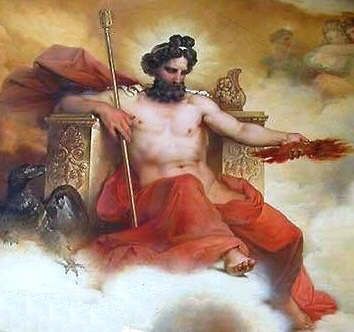
On what basis do we ground our belief that we are in any way important or significant? Indeed, there are even those who claim to be gods. We are so preoccupied with ourselves that we sometimes believe that reality exists only because we exist. In our minds, we have created gods in our own image, and we cannot imagine that anything we would call divine could not have the face of a naked narrow-nosed monkey. We believe that we worship God, but in fact we worship a monkey. This is because we cannot even imagine that any god could be unlike us.
In reality, however, everything we are, and the fact that we exist at all, is due to the unimaginable powers and laws of the universe, and not to the anthropomorphic creations of our imagination and our belief in them.
We gods, whom a virus invisible to the naked eye can kill in virtually an instant, have risen to the heights of our intellect and created weapons of mass destruction that have the power to annihilate our entire race, also in an instant.
But from the perspective of the eternal and infinite universe, this is of no significance. From a cosmic perspective, our entire planet is insignificant. In an instant, it could cease to exist, along with humans and their gods, and no one and nothing would care.
So instead of pretending to be gods or worshipping the products of our own imagination as gods, let us marvel at the fact that we exist at all and that we are aware of it, and let us be grateful to the real powers of the almighty cosmos, which in fact possesses the attributes assigned to our idea of a supernatural god. There is a real entity to which we can refer if we are looking for something greater than ourselves, something unimaginably bigger and older. Our life from its perspective is completely insignificant, but from our perspective, only in relation to it, it takes on the same incomprehensible meaning and the same value as its own existence. Not only are we a physical part of the universe, but we are also identical to it in a metaphysical sense.
Man, probably for reasons known only to the law of evolution, has attributed to the real, physical existence of the universe, with its powers and laws, the face of a narrow-nosed monkey and placed it outside it, outside what is real. At the same time, unable to understand the brutality and amorality of the natural laws of evolution that govern nature, man - the theologian - has attributed satanic characteristics to it. It seems that the abstract human mind needs to create abstract entities. This is why human science, art and culture have developed.
The same abstract mind of the entire human race, through science, not religion, may one day even lead man to achieve immortality.
In reality, we are not gods, but we have the right to strive for perfection and a superhuman state by stealing the secrets of the only truly existing being with the characteristics of a true god, yet devoid of a human face.
We did not invent fire, we stole its secret from nature. We did not create the laws of physics, we invented, thanks to our ability to think abstractly, mathematics as a language to describe reality.
What did we learn from the theistic god Yahweh? Hatred for all those who worship other imaginary gods, the humiliation of women, hatred for homosexuality, that working on Saturday is punishable by stoning, that if we eat pork, we will not enter heaven... What progress has humanity made thanks to the teachings and laws of this religion?
If we believed that by building a tower of stones to reach heaven we would provoke Yahweh to come down and confuse our languages, would we fly into space to find out that there is no heaven and no Yahweh, and that instead there is an inhuman entity whose magnitude exceeds our understanding and imagination, and that discovering its godless and amoral laws will cause us to send probes and telescopes into space? What have fairy tales about the healing miracles of Jesus given the world? How many people have left hospitals thanks to them? Why, instead of showing off his magic tricks, did he not tell his disciples, for example, about penicillin, that it is an antibiotic, and why was this not recorded in the supposedly holiest and infallible book, which would have saved millions of people? Because he had no idea about the existence of bacteria? But he did have a vast knowledge of demons possessing sinners. Apparently, according to Christians, this is what the world needed more.
It was the world of science that stole the secret of antibiotics from godless nature, not a made-up religion.
Even though we claim that God does not exist, probably referring to the malicious dwarf Yahweh or similar supernatural beings, do we call ourselves gods because we believe in the existence of divinity as something undefined, greater than ourselves, or do we reduce the concept of divinity to the belief that we can do whatever we want and no one will stop us, naively believing that we are masters of our own destiny? Among the citizens of so-called democratic countries, this belief is probably stronger, but in Afghanistan, Somalia or Iran, it is probably somewhat weaker. Wherever there are human communities, there are also agreed rules of conduct called laws, which individuals must obey, otherwise they will be punished. Similarly, there are physical, biological and chemical laws that humans must obey, otherwise they will be punished in the form of illness or death.
In view of the above, we must place our belief in divinity either deep within ourselves, believing that we can call ourselves gods because we have created our own criteria for what divinity is and no one can forbid us to do so, or we must direct this belief outward, toward something that is truly infinitely greater than ourselves.
It should also be added that we are generally most divine when we are young. With age, our level of divinity decreases significantly.
The human mind, probably for evolutionary and adaptive reasons, in order for the development of the human species to continue, created the need to experience something greater than man himself, some abstract ideal, an absolute, towards which man constantly strives. Constantly striving for it, we develop, dreaming of achieving divinity. And even if we never achieve true divinity, the path in search of it is important for our development.
A long time ago, an old sailor, looking with admiration at the North Star, probably knew that he would never reach it, but he knew that it would unerringly show him the way home.
Divinity can therefore take two forms: as an abstract entity, an undefined ideal in our minds, or as a real entity with properties and powers beyond our imagination. We can believe in one or the other, or both at the same time, or believe in nothing at all. For objective reality, for the perfectly indifferent cosmos, whether we believe in the objective truth about it, in its real characteristics, or not, is of no importance.
I recognise that from a metaphysical and theological point of view, Nature is god. An impersonal, satanic god. Physical, chemical and evolutionary biological laws are amoral and godless supreme laws. All human laws are merely conventional.
All other gods invented by man are his creations. Nature has divine and amoral power (omnipotence) that forces all living beings to obey its laws. Free will cannot oppose the physical laws of nature because it will result in death. In nature, the price for mistakes is death. Unless death is a free choice. In that case, we have the free choice to choose non-existence. However, death cannot be resisted. Death is one of the most important laws of amoral nature. Death is a good without which there would be no evolutionary development. Without death, without natural selection, thanks to which only the best-adapted individuals can survive, without genetic mutations, most of which are harmful (genetic defects and diseases are inevitable), there would be no evolutionary development of organisms. Without the amoral and satanic laws and powers of nature, life would be impossible.
You can accept this truth and achieve godless peace of mind, or escape into theistic fantasies of eternal life of an imaginary spirit after the death of the body as a reward for blind faith, but at the same time full of irrational fear of eternal punishment for succumbing to your true human and animal nature.
You can achieve true peace in a godless reality, or live in a state of irrational anxiety and fear of what or who awaits you after death.
However, if you are still looking for a god inside and outside, a god who will not be an escape from this world, but on the contrary, will be real and immanent, then I invite you to try the Ecclesia Luciferi method of looking inside your mind and summoning from there the abstract Luciferian and superhuman being residing in the darkness of your subconscious. A being to whom Christian theism, hostile to everything natural, has assigned power over this world. So that you may bring out your true self from there, as your amoral instincts make you, and in your mind unite this being with the amoral and omnipotent forces of the universe and believe that you and your mind and subconscious and nature and the cosmos are a unity that is as mysterious and surprising and eternal as the universe itself. This eternity cannot be destroyed.
In this way, you will come as close as possible to the only true inhuman divinity. And then you will see reality as sharply and clearly as if you had attained enlightenment. You will see everything through the eyes of the enemy of this reality of a theistic god that poisons the sober mind, through the eyes of the one whose name is Satan.
Gloria Satanae!
Gloria Trinitati Impiae!
LCFNS